Abe and Paddy
We are not enemies, but friends. We must not be enemies. Though passion may have strained, it must not break our bonds of affection. The mystic chords of memory, stretching from every battle-field, and patriot grave, to every living heart and hearth-stone, all over this broad land, will yet swell the chorus of the Union, when again touched, as surely they will be, by the better angels of our nature. Abe Lincoln's First Inaugural Address - March 4, 1861
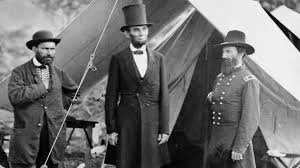
In 1847 Abe Lincoln became aware of the Potato Famine then devastating Ireland. He was a lawyer who worked as a travelling judge at the time and was about to be sworn in as the Representative of Congressional District Seven from Illinois. He had debts to pay and wasn’t wealthy.
Yet he was moved enough by the plight of the Irish that he contributed ten dollars to a famine relief fund. From his own pocket, not campaign funds, one hopes.
Ten dollars was a lot of money in 1847 America. Lincoln could have bought a new tailored suit for that much. The blue-collar worker was making a dollar a day, if he was lucky. With ten dollars you could buy eight acres of land out west.
Why does this ten dollar donation to famine relief matter? Because though Lincoln never came remotely close to winning the Irish vote when he ran for President – twice – he never tried to score political points by demonizing the Irish immigrants. He didn’t throw our ancestors under the bus. His donation to famine relief shows a generosity, a better angel.
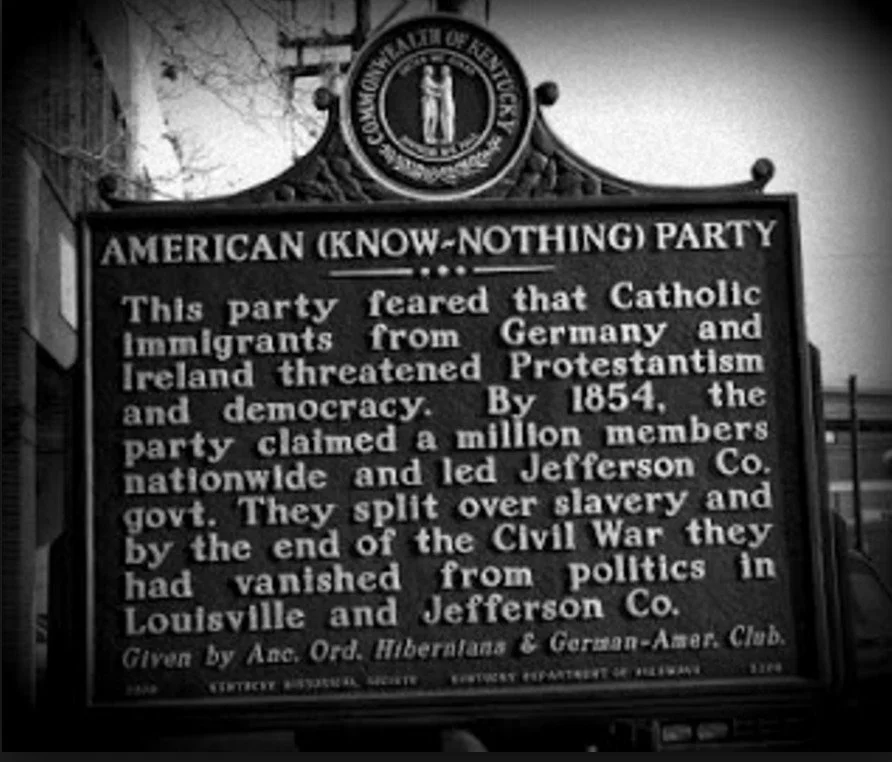
The greatest favor Lincoln ever did the Irish was to denounce and defeat the Know Nothing Party
Ten years before that donation, Abe Lincoln had arrived in Springfield, Ill. to see if he could make a living as a lawyer. He rented a room above the local general store owned by Josiah Speed. He and the young Kentuckian became best friends; they even shared a large bed, which wasn’t unusual in those days. The closeness of the two men endured through the years, which makes the following letter Lincoln wrote to Speed in 1855 so significant. Lincoln's Whig Pary was falling apart. The Republican Party was just forming. He wanted nothing to do with the nativist, virulently anti-immigrant and anti-catholic Know Nothings.
"I am not a Know-Nothing. That is certain,” he assured Speed.
“How can anyone who abhors the oppression of negroes, be in favor of degrading classes of white people? (Know Nothings and many Abolitionists were notoriously anti-Irish immigrant.) Our progress in degeneracy appears to me to be pretty rapid. (The last decade had seen many violent attacks on Irish Catholics.) As a nation, we began by declaring that 'all men are created equal.' We now practically read it 'all men are created equal, except negroes.' When the Know-Nothings get control, it will read 'all men are created equal, except negroes, and foreigners, and catholics.' (Remember, this wasn’t political, this was a letter to an old friend no,t a press release or speech; Lincoln could speak from his heart.) When it comes to this I should prefer emigrating to some country where they make no pretence of loving liberty—to Russia, for instance, where despotism can be taken pure, and without the base alloy of hypocracy." (Russia in 1855 was basically a police state. The Czar Nicholas I was dead; financial collapse and revolution were in the air.)
Lincoln went on to win the White House in 1860 and 1864 with very few votes from Irish Catholic voters. The Know Nothing Party peaked in 1855 and rapidly declined; split, like America, over slavery and immigration.
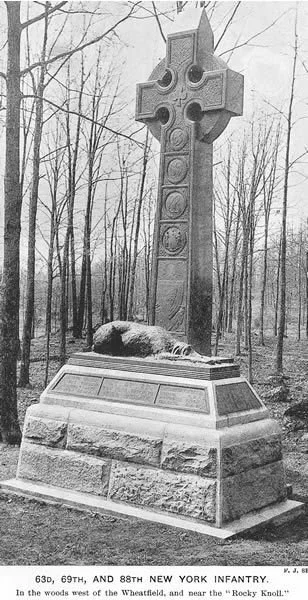
Monument to some of the Irish Brigades who fought at Gettysburg.
How Irish immigrants helped win the Civil War
Shortly after the South began its effort to secede from the Union by bombing Fort Sumter in 1861, thousands of Irish Catholics gathered in New York‘s Union Square for a massive rally. Richard O’Gorman who had t,o get out of Ireland after fighting the British in 1848, spoke of leaving his status as a subject of the Crown behind, “When I assumed the rights of a citizen, I assumed, too, the duties of a citizen. Lincoln is not the President of my choice. No matter. He is the President chosen under the Constitution.”
Eventually, 150,000 Irish would serve in the Union Army. Fág an Bealach - Clear the way - was he battle cry in Irish for the troops, who made the difference in key battles. (25,000 Irish enlisted as Confederates but that's a story for another day.)
The casualty rate among Irish soldiers was staggerng. That took its toll—not only on the ranks, but on the morale of home-front Irish Catholics. Two weeks after Gettysburg, New York Irish rioted, looted, burned, and murdered civilians—predominately Blacks—to protest the new military draft. Irishmen once willing to defend the Union now came to believe they were fighting to liberate emancipated Blacks whom they feared would undercut their already low wages. They had signed up for other reasons: To stop Southern secession, to make some money, to show they were true Americans ready to fight and die and to train for a military confrontation with the British back in Ireland.
The number of Irish who served in the Union Army was second only to the number of Germans fighting to keep their new country together. When Medals of Honor were handed out, 146 went to men with Irish surnames; the Irish were the largest immigrant group represented by far. The first two soldiers killed at Fort Sumter, both born in Ireland, were among the recipients.
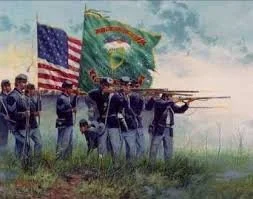
Irish-born Major General Thomas Francis Meagher confirmed that his Union troops greatly enjoyed Lincoln’s “affable manner and cheerful badinage,” which “made him an especial favorite with these rough-and-ready appreciators of genuine kindness and good humor.”