Overlooked Irish American tradition explained
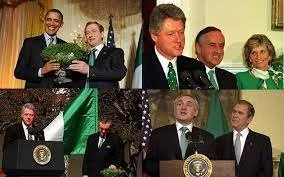
Every March the leaders of Ireland and the United States meet at the White House and every year an official proclamation about Irish-American Heritage Month is issued. Have you ever read one?
Just another way to attract the Irish Vote?
It wouldn’t be March without the annual reminder from the White House about this being Irish-American Heritage Month. Every year an official proclamation reminds us how the people from that small island off an island in the North Atlantic and their millions of descendants have done so much to make America great. Again, and again.
The Irish have been coming to America since before it was America, but the Proclamations each March have only been a thing since 1991. No one reads them. But someone has to write them. (I’m betting that nowadays instead of an entry level staffer getting the assignment, it goes right to AI.) You can read them all right here.
Is the ethnic self-esteem of the Irish so low that it needs pumping up by proclamation? Doubtful. So why does the White House keep putting them out?
An Irish newspaper called the Freeman’s Journal figured it out in 1920, long before the first one was issued. “A good many Englishmen and a good many Irishmen understand that these resolutions and proclamations mean nothing at all, the White House and Congress do not express opinion on matters of this sort except for the purpose of getting votes.”
There have been 32 of these Irish-American accomplishment statements published in the Federal Register since 1994. I went back and read them so you don’t have to.
When the Proclamation stopped mentioning Ireland's Potato Famine
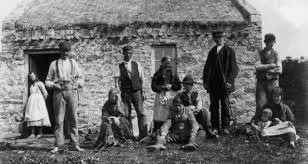
An Gorta Mor – the Great Hunger in Ireland - which lasted from 1845 to 1852, is a point of reference in the proclamations until 2017, when Donald Trump issued the first of his first administration. His predecessors in the Oval Office leaned into the adversity overcome by famine emigrants. “... millions of Irish immigrants who came to the United States in the 19th century were fleeing not only persecution, but also the specter of starvation and disease brought on by the Great Hunger, the devastating potato famine that began in the 1840s,” according to the 1998 proclamation issued on Bill Clinton’s watch. In 1995 he reminded us, "Throughout the country, they faced callous discrimination: ``No Irish Need Apply'' signs were ugly reminders of the prejudice that disfigured our society.” Surprisingly, Joe Biden, the most Irish president since JFK, never mentioned the Famine in his four proclamations. That's probably because his writers concentrated on Biden’s family story. “By 1909, my grandparents Ambrose Finnegan and Geraldine Blewitt met and married in Scranton, Pennsylvania, and passed on to my mother, Catherine Eugenia Finnegan Biden, a pride and a passion that runs through the bloodstream of all Irish-Americans.” Proclamation March 2021. There was no space left for the famine.
Trump's proclamation mentioned the Famine in 2019 but has taken the message in a different direction this term. His predecessors spoke of the Irish “fleeing the famine.” But Trump in 2025 says, “they crossed the ocean in search of the American dream.” Nothing about escaping the English nightmare.
Exactly how many Irish-Americans are there?
You’ll hear different numbers thrown around this month estimating the number of Americans who have some Irish blood in ‘em. Don’t look to the official proclamations for clarity.
In 1996, Bill Clinton declared, “I am pleased to count myself among the over 40 million Americans who can trace their heritage back to Ireland.” BY 2001, the numbers were up, according to George W. Bush (41), “Today, the more than 44 million Americans who claim Irish heritage look back with pride on the achievements and contributions of their forebears.” By 2017, millions of those Irish Americans disappeared, "From Dublin, California, to Limerick, Maine, from Emerald Isle, North Carolina, to Shamrock, Texas, we are reminded of the more than 35 million Americans of Irish descent who contribute every day to all facets of life in the United States,” according to Trump’s first proclamation. The numbers took another hit one year later. “Irish-American Heritage Month is a great opportunity to celebrate the nearly 33 million Americans with Irish ancestry.”
How did we go from 44 million to nearly 33 million? Here’s the deal. According to the latest U.S. Census, 32 to 33 million Americans say Irish is their first ancestry. The numbers go up to 40 to 45 million when people name their second ancestry as Irish.

Look who has roots in Ireland
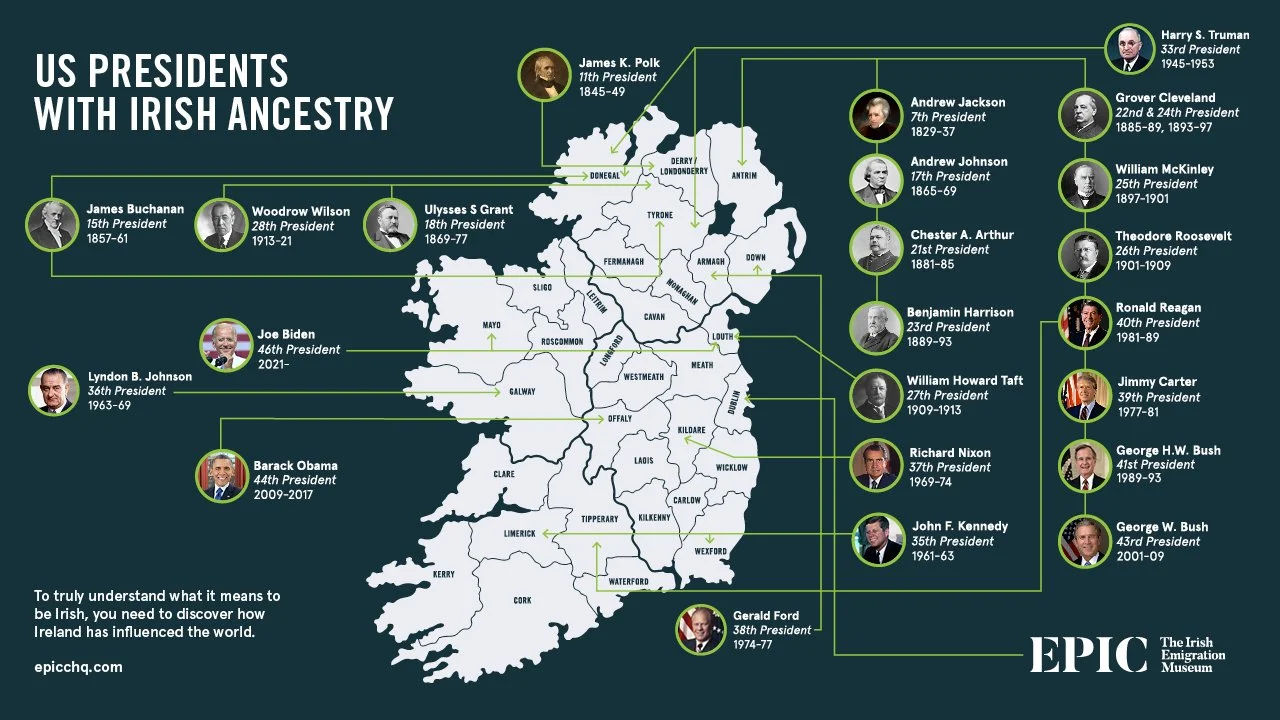
Presidents can be great name droppers in these proclamations. The Irish American who receives the most mentions is Henry Ford. His father emigrated from County Cork, his mom was Belgian. Here’s a who’s who of famous Irish Americans cited by the White House since 1991. Some are more Irish than others. George Washington, Andrew Jackson, John F. Kennedy, Ronald Reagan, Bill Clinton, Barack Obama, Joe Biden, Tip O'Neill, George M. Cohan, Flannery O'Connor, Georgia O'Keefe, Edgar Allen Poe, F. Scott Fitzgerald, Andrew Mellon, Will Rogers, Spencer Tracy, Bing Crosby, John Wayne, General Douglas MacArthur, Sandra Day O'Connor, John Boyle O'Reilly, Ring Lardner, Mary McCarthy, John Barry, Justice William Brennan, Maria McCreery, Governor Al Smith, Ambassador Mike Mansfield, Gregory Peck, Helen Hayes, Audie Murphy, Leonora Barry, Mary Kenney O'Sullivan, Buffalo Bill Cody, Daniel Boone, Davy Crockett, Eugene O'Neill, John O'Hara, Matthew Brady, Jackie Gleason, Gene Kelly and Edmund McIlhenny.
The 2026 Irish-America Heritage Month Proclamation from the White House should be released any day now.