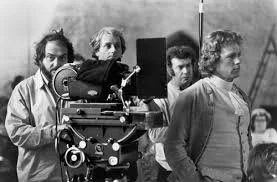
Was this really the Greatest Irish Film of all time?
If this were a podcast, I’d spend the next 15 minutes talking about myself; what I thought of Barry Lyndon , when I watched it, where I would rank it, and whether I think it’s actually an Irish movie.
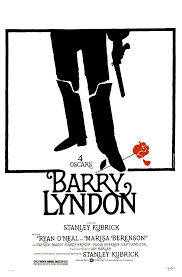
Enough about me. I enjoyed watching and rewatching it but would have a hard time recommending you watch this three-hour, 50-year-old costume drama unless you really love the movies. Stanly Kubrick is one of the greatest directors ever, but he made better films (A Clockwork Orange, 2001, The Shining). The fact that the IRA shut down the multi-million-dollar production in 1974 is interesting, but not reason enough to watch it.
For some reason, the Irish Times named it the Greatest Irish Film of All Time five years ago. The two reporters who created the list wrote, "This is not a ranking of Irishness. Once a film has qualified it competes equally with all others. Some may reasonably think our top film among the least Irish of the bunch. So be it.”
And so it is.
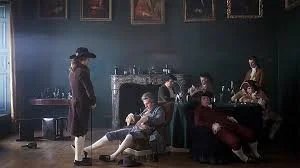
This scene, which looks like a painting for for a man cave, comes near thr end of the fall of Barry Lyndon (Ryan O'Neal) center. Costumes won an Oscar, as did Cinematography, Music and Art Direction.
THE RISE AND FALL AND RISE OF BARRY LYNDON
Once upon a time in Ireland (1973), an American director who lived in England made a movie baed on a book by a British author who made fun in print of The Great Famine. Barry Lyndon flopped at the box office. Critics “flayed the film” said one of its stars. The shooting of the film on location all over Ireland ended abruptly when the Provisional IRA allegedly sent Kubrick death threats. Though nominated for seven Oscars, it was shut out of the major categories on awards night in March 1976. For years, this three-hour period piece was considered one of Kubrick’s lesser cinematic accomplishments.
But time has been kind to Barry Lyndon. “In one instance, the same critic who originally rapped the film has several years later put it on an all-time best list,” said Stanley Kubrick the eccentric, obsessive auteur who made Barry Lyndon. Vindication was complete in 2020 when the Irish Times published its list of the greatest Irish films of all time.
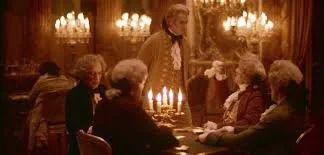
Kubrick used no artificial light in the filming of Barry Lyndon. Much was shot by the light of special large candes with a camra lens designed by NASA for the moon landing. (Really) He didn't use any studio sets either. All scenes like this were filmed inside old "giant houses."
HOW IT CAME TO BE NAMED "GEATEST IRISH FILM EVER"
Not many movie fans would mention Barry Lyndon if asked to name the greatest Irish film of all time. (It probably wouldn’t even register as Kubrick’s greatest.)
So, imagine the shock among readers who made their way down the list of 50 films on May 2. 2020.
NUMBER ONE - Barry Lyndon. Stanley Kubrick, 1975. An 18th-century Irish scoundrel (Ryan O'Neal) makes his way across Europe and wins the heart of a noblewoman (Marisa Berenson), only to succumb to "Misfortunes and Disasters" as the intertitle puts it. Cinematography that requires Nasa tech. Stately composition. Bach, Vivaldi, and The Chieftains. Forget The Shining and 2001. This is Kubrick's masterpiece.
But, but, but THE GREATEST IRISH FILM OF ALL TIME?
Even though the first 35 minutes of this story of a struggling, self-loathing, joyless 18th-century Irish rogue were filmed in Ireland, it’s hard to imagine anyone considering it the equal of such Irish classics as My Left Foot (#10 on the Times list), The Wind That Shakes the Barley (9) , Banshees of Inisherin (came out after the list was published) or The Dead (2).
How did it ever get to be Ireland’s Number One?
Let's give the Times the benefit of the doubt. The muscial score is very Irish with the Chieftains and Sean O'Riada contributing. The southeast Ireland scenery in Act One is jaw-dropping. The main character is an Irish Protestant; commoner Desmond Barry changes his name when he marries British money. The cast and crew were mostly Irish until Kubrick switched locations.
Let's withdraw that benefit. The director's not Irish, in fact he's a confrmed Anglophile. The star, Ryan O'Neal (Peyton Place, Love Story) has an irish name but little interest in his heitage. The money to make the movie came not from Ireland but from Warner Brothers. William Makepeac Thckeray (Vanity Fair) who wrote the book in 1844 would turn to writing about the Famine in Ireland for Punch magazine and assigning blame to the character of the Irish people. Besides, how can you call a movie Irish if not one Celtic Cross is seen? (Nor are Cathilics seen for that matter.)
The Irish Times wold hear no such objections.."Some may reasonably think our top film among the least Irish of the bunch. So be it.”
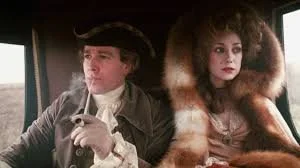
Any sympathy for Barry Lyndon went out the window with this scene. Lady Lyndon (Maria Berenson) asks him to stop smoking his pipe. He pauses. Then blows smoke into her face.
Told to get out of Ireland in 24 hours, Kubrick was gone in 12
Now, about that total shutdown of production in Ireland in Jan.1974 within 48 hours of receiving bomb threats from the Provisional IRA (before it started getting arms from Libya).
After five months of filming in several locations in Ireland, a hairdresser received a telephoned threat from someone claiming to be with the IRA. Bombs would go off unless production was stopped, she was told. Kubrick’s use of costumed British troops marching on Irish soil around Wicklow would not be tolerated, the IRA supposedly said. The eccentric but brilliant director was obsessive about security and The Troubles were raging. He was told to get out of Ireland within 24 hours. He was on a ferry from Dun Laoghaire to Liverpool with his family within 12 hours. The entire production was shut down. It basically disappeared within 48 hours of the telephoned threats. (Think of hundreds of extras, craft workers, technicians, etc. suddenly out of work).
“Stanley was not willing to take the risk. He was threatened, and he packed his bag and went home. And the whole crew went with him. Within 48 hours, we were all back in the southwest of England. Luckily we had really what we needed: one or two shots we would have done in Dublin Castle, we then transferred to a stately home in England. But the bulk of the film was made in Ireland.” Jan Harlan – Kubrick's bother in law and assistant.
Breaking News
Netflix now owns Barry Lyndon. So, who knows, you may soon have the option of streaming this GOAT of Irish films before the Irish Times releases its next ranking.